Posts

Showing posts from February, 2020

Building Orientation and Energy Efficiency, Part 2
Image
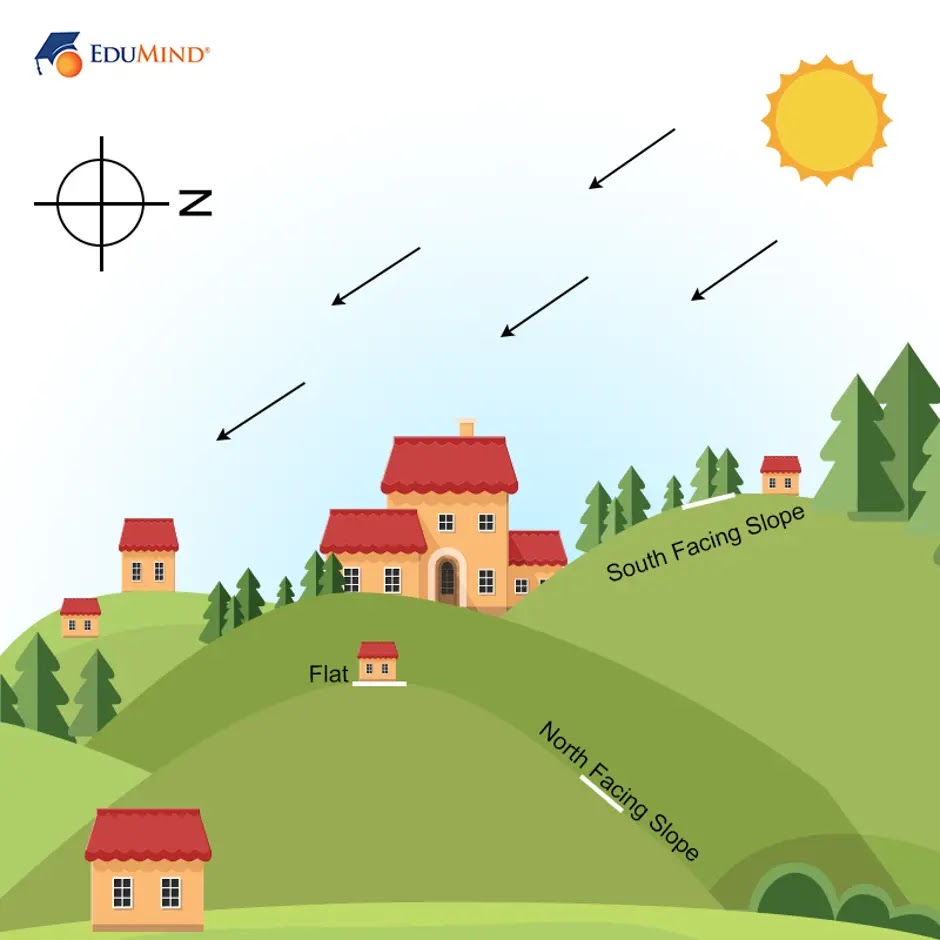
Part 1 of Building Orientation and Energy Efficiency examined the role of building siting and passive strategies according to the major climatic regions. As a recap, those four major climatic regions are: cold, temperate, hot-arid and hot-humid.  We covered the orientation in plan regarding sun exposure and internal heat gains for the benefit (or detriment) of the building. In addition to location in plan on the site, the vertical orientation of a building-especially on a hill-is also as important.  Air moves with temperature and terrain. Different terrains channel the wind in varying paths. These-along with the climate regions-create microclimates, which are essentially the climates of the immediate site based on a very local set of conditions. Besides the terrain channeling or dispersing/moving wind in unique ways, we must also recognize how temperature affects air movement.  Hot air rises because it is less dense than cold air. During the day, air moves o...

Building Orientation and Energy Efficiency, Part 1

Image
Mechanical systems consume a lot of energy in buildings-approximately 35% of a building's total energy use. While HVAC equipment is becoming more efficient, the main strategies that can reduce building energy consumption start at building planning and siting.  There are four major categories for climatic regions: hot-arid, cold, temperate, and hot-humid. Each of these regions offers a unique set of climate conditions when designing a building. Regarding the design of mechanical systems, these regions determine if the building needs more heating, more cooling, more or less humidification, or a balanced system. Not understanding this and designing a building without considering its integration with the climate could potentially create an environment that is inefficient and more taxing on the environment and resources.  Designing an efficient building begins with the building site. One of the first steps that the designer should consider is the climatic region of the pr...

Thermal Comfort

What makes the human body thermally comfortable? It's not just temperature alone. A common misconception is that thermal comfort-the state in which the mind is comfortable with the thermal environment-is strictly due to air temperature. However, our bodies are complex organisms and as such, it takes a lot more to make us comfortable or uncomfortable.  In addition to air temperature-that is just one puzzle piece-factors such as relative humidity, activity, mean radiant temperature, and air motion all play into comfort. Air temperature is the temperature of the air measured as the dry-bulb temperature-the temperature of the air without humidity or moisture. Relative humidity accounts for the moisture, or humidity, in the air. The mean radiant temperature measures the temperature radiating off of surfaces. Then there is the movement of air. Oftentimes, the weather seems a lot cooler due to increased wind speeds (wind chill) on a cool or cold day (or vice versa). In addition to t...

IIC vs STC

When it comes to sound, there are multiple ways to determine the movement of noise through assemblies. Sound travels in many different ways and as waves. Different ratings depend on the medium through which the sound waves travel. The emphasis tends to be placed on STC (sound transmission class) ratings, but others are just as important-or maybe more applicable-depending on the situation. This post will focus on the difference between IIC and STC-both very common ways to measure the transmission of sound through assemblies but approaching the source of sound differently.  The STC rating is concerned with the travel of sound or noise (sound above a certain threshold for which it is considered unwanted) through the air. The STC measures how well an assembly of materials absorbs the transmission of airborne sound/noise. Assemblies not only include interior partition walls, ceilings/floors, and exterior walls, but also include windows, doors, and so on.  However, sound ...

Gross Versus Net Square Feet with Code

There are some instances when gross and net square footage are calculated. Gross square footage generally refers to all of the square feet, whereas the net square footage accounts for some subtractions. An example for this could pertain to cost estimating, where gross square feet would include the interior floor space as well as interior and exterior walls. It would account for "all" of it, with the exception of open courts within a building, walls that extend outside of the footprint of the building/roof overhang at ground level, and so on.  With net square footage, there is typically an accounting of some loss. Again, considering cost estimating, net square footage accounts for floor space but does not account for exterior walls and other elements such as corridors, toilets, mechanical rooms.  With gross square footage and how it pertains to code... Well, this is where it gets a little tricky because it does not follow that typical definition and tends to trip u...

Project Management: Change Orders

One of the most frustrating parts of a construction project can be change orders. They have given a building project a bad reputation but oftentimes, they are inevitable. Things change. This can be due to field conditions and uncovering something unexpected, or it can be due to a design change per to a client or the architect. Rather than not accept any changes whatsoever (which is, more often than not, unrealistic), changes are accounted for and built into the process. In architects' contracts, contingencies are often included to cover design changes should they arise. Contingencies may also be included in construction contracts to cover construction costs associated with changes. In documentation, changes are handled using three different methods to formally change the contract for construction/contract documents:  1.An architect's supplemental instruction (ASI)  2.(Formal) change orders  3.Construction change directive  Any change will have a connect...

Programming and Analysis: Owner's Responsibilities/Surveys

The roles of the parties involved in a construction project are of critical importance. Clear responsibilities contribute to a process that runs more smoothly, promotes better communication, and hopefully makes the process less contentious. The roles of the owner, architect, and contractor are outlined in the AIA contracts. In general, the architect is responsible for the design intent, the contractor for the work and construction site, and the owner for the site.  The owner's responsibilities to the site include possessing the information necessary to understand site conditions. This includes (but may not be exclusive to) geotechnical reports and surveys. The reason why the owner is responsible for the site is essentially tied to risk. The Owner, in regard to the existing site conditions, is the party to whom it is most appropriate to assign that risk.  There is not one but multiple surveys to consider. The most common surveys are metes and bounds, plat of survey, a...

AIA Code of Ethics and Professional Conduct

Image
A membership in the American Institute of Architects (AIA) in any capacity brings with it an expectation for the highest standards in competency, professionalism, and integrity. The AIA lays out what is expected of its members through the AIA Code of Ethics and Professional Conduct ("the Code of Ethics"). It is important for both candidates taking the Architectural Registration Examination (ARE) and those with an AIA professional affiliation to understand this Code of Ethics because noncompliance can lead to disciplinary action. To understand compliance, the Code of Ethics must be understood. You can access this code for free on the AIA's website (aia.org).  The AIA's Code of Ethics begins with a preamble which, among other information, includes descriptions of its three tiers. I am not going to elaborate on the rest of the information beyond the three tiers, with a little explanation, but what is interesting is the history of the AIA and antitrust. Due to t...