Posts

Showing posts from August, 2020

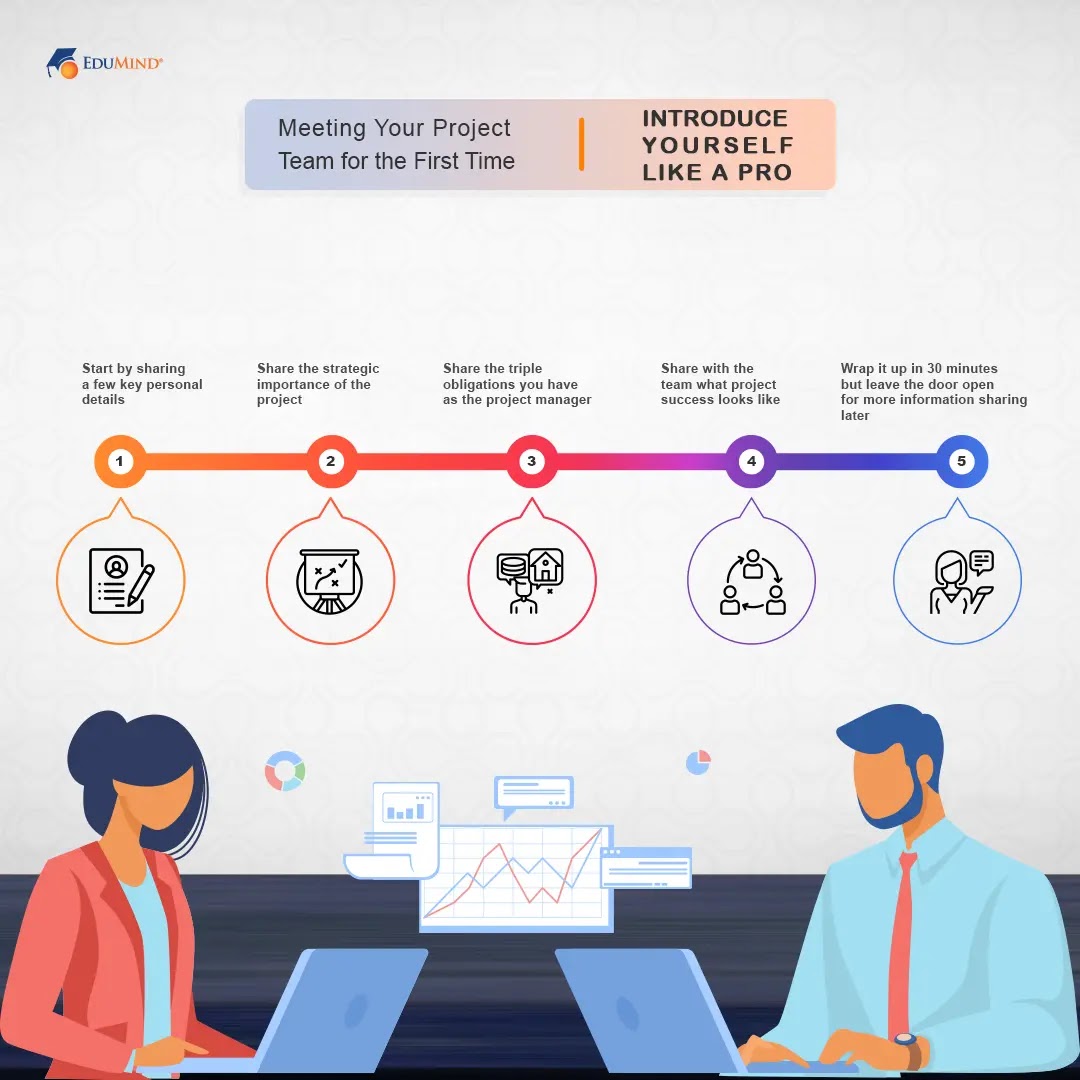
Meeting Your Project Team for the First Time: Introduce Yourself Like A Pro
Image
Are you taking over a new project team? Are you meeting your new team for the first time? This information is for you if so. How you introduce yourself will either confirm or inform your team's expectations. Your introduction will either motivate or deflate. Make it count, make it professional. Here's how the professionals do it:  Table of Contents 1. Start by sharing a few key personal details 2. Share the strategic importance of the project 3. Share the triple obligations you have as the project manager 4. Share with the team what project success looks like 5. Wrap it up in 30 minutes but leave the door open for more information sharing later Start by sharing a few key personal details:  For example, you might share your previous role either in the same organization or another, along with the nature of the work you did. You could share your marital status, the number of children, and pets. Yo...
ARE 5.0 Demo and Testing Strategies

To best perform on the Architect Registration Examination (ARE) and all six of its divisions, it is imperative to be familiar with the exam format. The last thing an exam candidate should do is to show up on test day without any experience with practice exams. I found that, for me, half of the battle was learning the format of the exam. A great aspect of the exam is that it is consistent across all divisions. It follows the same format which promotes familiarization. Once that format became more familiar, I found myself becoming confident enough to test out strategies.  The majority of the ARE 5.0 consists of discrete items and case studies. Because the exam is timed, many test-takers suggest completing the case studies first. The case studies involve looking at resources that may take some time. Completing the case studies first allows for getting the most time-consuming part out of the way.  I found my strategy was to do a once-through until I got to the case studies, meanin...

How to Get Motivated After Failing the ARE 5.0

Image
There are a few certainties in life: death, taxes, and failing a division of the Architect Registration Examination (ARE). Okay, some people have passed all the divisions on the first try (not me), but if you look at the passing rates-hovering around 50 percent, with one division in the 60s and another at 70 percent-the odds are against you. A fail is frustrating. An already long journey has become longer. It's a sinking feeling, but don't give up.  One of the best sayings that I heard from taking the ARE 5.0 was that you don't fail, you just don't pass . Many will admit that if they had to take an exam again after a pass, they may very well fail. It can go either way. The goal is not to let it derail your progress.  When you fail an exam, or even after you take an exam regardless of pass/fail, take a day or two off from studying. Go out to dinner and reconnect with the world. Blow off some steam so you are ready to get back in the ring. Give your brain a rest. I sugge...

How to Read an ARE 5.0 Score Report

When taking the Architect Registration Examination (ARE), the candidate has the option to view their provisional score at the conclusion of the exam. The provisional score allows the candidate to see whether or not they have passed the exam, pending further approval. Viewing the provisional score is an option, not a requirement, so one can skip that step if desired. If the candidate chooses not to review the provisional score, they will get their pass/fail and a Score Report within a short period of time.  The National Council of Architectural Registration Boards (NCARB) tests minimum competency and the cut score is between 57 and 68 percent, depending upon the exam. NCARB does not issue an actual test score. Instead, they simply note a pass or fail. The Score Report is the only way to assess how the candidate performed on the exam. However, there are very few specifics.  At the top of the Score Report, you will find the division taken, whether it is a pass or a fail, and the...

The Best Time to Take the ARE 5.0

Image
The process of becoming an architect is not an easy one. According to the National Council of Architectural Registration Boards (NCARB), after 5.6 years of education, data shows that it takes about 4.6 years to satisfy the Architectural Experience Program  (AXP) requirements needed to sit for the Architect Registration Examination (ARE).  At that time, the average age of a candidate is around 33 years old. In addition to that, it takes an average of 2.2 years to complete all six divisions of the exam. One of the most common concerns I hear about the exams is that life is well underway when a candidate becomes eligible to sit for them. In addition to work obligations (the hours and demands of the profession), a candidate often has a busy personal life as well, typically with a young family. This can get discouraging when faced with the task of completing the exams and becoming a licensed architect. The question is: When is the best time to take the exams given the time needed...

Best Way to Reinforce ARE 5.0 Study Material

Studying for the Architect Registration Examination (ARE) is a daunting task. When embarking on the journey, the hardest part is figuring out where to start. The value of an exam preparation course is that it gives organization to the vast amount of content these exams cover. On top of that, reputable prep courses are developed by those who are experienced in the profession and with the ARE 5.0.  However, third-party materials should not be the only part of the process. Studying is reinforced through multiple other resources including readings, resources, flashcards, practice exams, videos, and more. It is necessary to access other resources when studying for these exams.  The ARE 5.0 Handbook provides a list of resources and references to study for each division of the exam. What is often daunting about the list is that, combined, the resources are thousands of pages and thousands of dollars. Researching which select resources are recommended for the exam can start to whittl...

Ultimate Guide to the Five Primary Documents of Any Project

Projects are document intensive. Project documentation serves a myriad of purposes including project selection, design, engineering, management, implementation, and control to name a few. One indicator of the density of project documentation is the 1,600-plus hits returned when the latest edition of The Guide to the Project Management Body of Knowledge (PMBOK Guide) is searched using "document" as the keyword. That number tells the story of how interrelated and interwoven documents are in the many actions and activities of a project. No matter the use or need, project documents have one thing in common. At their core, documents are communications tools. Their purpose is to transfer project understanding and knowledge.  Project documentation is divided into two groups: "primary" and "secondary." Primary documentation contains information not previously created or used before. Primary documents are the original and "first-source" of the informatio...

Why should I get a PMP?

There are many reasons to earn the Project Management Professional (PMP) designation. One is its global appeal. The number of PMP holders has now reached 1 million, across more than 200 countries, according to the issuing organization, the U.S.-based Project Management Institute (PMI). By comparison, a similar designation issued by the International Project Management Association (IPMA), headquartered in the Netherlands, has a fraction of the holders, and represents far fewer countries (approximately 70).  Many consider the PMP to be the de facto world-standard in project management. Supporting its strong multinational use is the availability of the PMP examination in many languages. Whereas the IPMA examination is currently available in English, German, and Polish, PMI offers the PMP examination in 14 languages including Chinese. Earning a PMP means recognition as a Project Management Professional no matter where your next project takes you.  Another reason to earn the PMP, a...